Beyond the Recycle Bin: Designing UX for a Circular Economy

For the 100th time, I click to trash something, forcing myself to think about how I was emptying my device of stuff I have no use for anymore.
I couldn’t for long. My brain chose to go the other route, telling me how I wasn’t really emptying anything.
Add to it what I already knew: that my actions, like billions others (in only the minute that had passed since I got thinking about this), had already triggered digital trash.
The digital recycle bin makes for quite the satisfying click, doesn’t it? A file vanishes, and we’re done. This metaphor, however, is nothing but a lie. In the physical world, there is no “away” and it’s certainly not as simple to delete things we have no use for anymore.
In its March 2024 report, the UN’s 2024 Global E-waste Monitor reports 62 million tonnes of e-waste generated in 2022, with only 22% properly recycled. Every device, whether a smartphone, laptop, or appliance has a lifecycle that extends far beyond its use, impacting ecosystems and resources.
As UX designers, we don’t just craft interfaces; we shape how people interact with these objects, giving us a profound opportunity, as well as responsibility, to design for a circular economy.
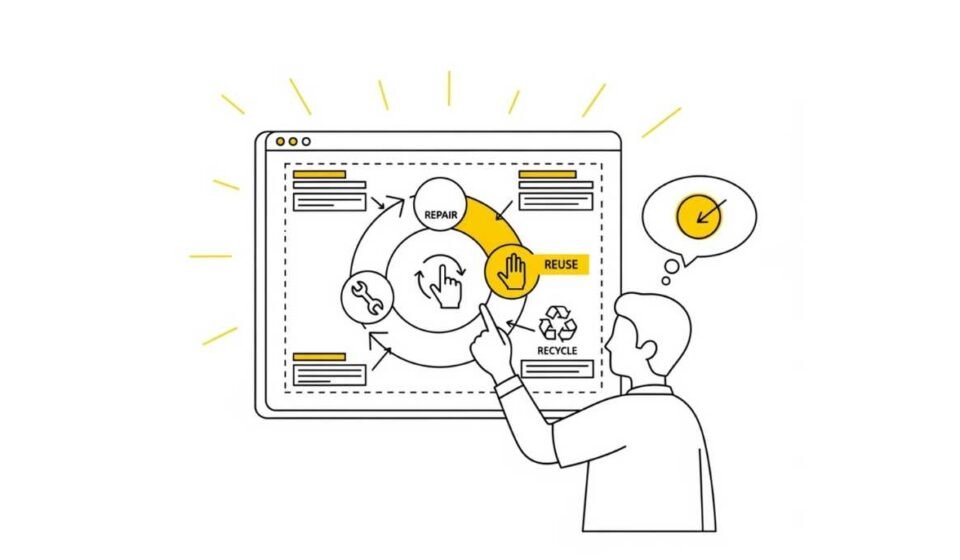
A circular economy reimagines the linear “make, use, dispose” model, prioritizing repair, reuse, and recycling to keep materials in use and minimize waste. Our role is to make these sustainable behaviors not just possible but intuitive, desirable, and even delightful. This requires a shift from designing for consumption to designing for stewardship, embedding circular principles into every interaction.
Explore with me five UX patterns to drive this transformation:
#1 - The Repairability Dashboard
Repair is the cornerstone of a circular economy, yet many products are designed to be replaced, not fixed. The global “Right to Repair” movement—bolstered by 2023 EU regulations mandating repairability information—demands a new approach. A Repairability Dashboard integrates repair into a product’s digital experience, turning a broken item from a source of frustration into an opportunity for empowerment.
Description: A centralized, interactive hub within a product’s app or web portal, providing tools to diagnose, troubleshoot, and repair an item. Imagine a user scanning a QR code on a malfunctioning kitchen appliance and landing on a tailored interface that feels like a trusted guide.
Design Principles:
- Clarity and Guidance: Use a conversational, step-by-step diagnostic flow, asking questions like “Is the device powering on?” to pinpoint issues. Avoid jargon, ensuring accessibility for non-technical users.
- Visual Storytelling: Incorporate high-resolution videos or interactive 3D models that zoom into specific components, showing exactly how to replace a part. Animation enhances understanding, making complex repairs feel approachable.
- Frictionless Procurement: Embed a marketplace for official spare parts, with clear pricing and availability. Design filters to match parts to the user’s specific model, reducing errors.
- Contextual Support: Integrate geolocation APIs to display nearby certified repair shops, with scheduling options and user reviews for trust.
Why It Works: By anticipating user needs—confusion, hesitation, or lack of expertise—this dashboard leverages progressive disclosure to guide without overwhelming. It transforms repair into an empowering narrative, aligning with users’ desire for autonomy and sustainability.
#2 - The Integrated Resale Flow
The second-hand market is projected to grow significantly, with apparel resale alone expected to reach $350 billion by 2027. Yet, reselling products is often fraught with friction—complex listings, pricing uncertainty, or buyer skepticism. UX can make resale as seamless as buying new, extending product lifecycles.
Description: An in-app flow that enables users to list a product for sale on a brand-managed or peer-to-peer marketplace with minimal effort, directly from the product’s digital profile.
Design Principles:
- Effortless Initiation: Place a prominent “Resell This Item” button in the product’s interface, pre-populating details like model, age, and specifications. Minimize user input to reduce abandonment.
- Data-Driven Confidence: Use real-time market data to suggest dynamic pricing based on condition and demand. Visualize price trends in a simple graph to build trust in the process.
- Trust by Design: Incorporate a verification badge for listings originating from the product’s official app, signaling authenticity to buyers. Use clean typography and minimalistic design to convey reliability.
- Seamless Logistics: Offer integrated shipping options (e.g., pre-paid labels) or local pickup coordination, with clear progress bars to track the process.
Why It Works: This flow reduces decision-making complexity by streamlining choices. By embedding resale into the product’s ecosystem, it feels like a natural extension of ownership, encouraging users to see products as assets with ongoing value.
#3 - The Effortless Take-Back
When products can’t be repaired or resold, they must be recycled or refurbished, not discarded. Take-back programs often fail due to logistical hurdles—confusing processes or lack of motivation. UX can make returns feel as effortless as online shopping.
Description: A user flow that simplifies returning a product for end-of-life processing, with clear incentives and minimal steps.
Design Principles:
- Proactive Engagement: Use predictive analytics to send notifications when a product nears its lifespan’s end, with a clear call-to-action like “Recycle or Upgrade Now.” Time these to align with user habits, like evening app usage.
- Frictionless Execution: Design a one-tap process to generate pre-paid shipping labels or QR codes for no-box drop-offs at partner locations (e.g., postal services). Use bold, action-oriented buttons and progress indicators.
- Motivational Incentives: Offer tangible rewards—store credits, discounts, or charitable donations—displayed prominently to drive action. Use micro-animations to celebrate completion, reinforcing positive behavior.
- Transparency: Provide a tracking interface showing the return’s journey and material reuse (e.g., “Your phone’s components are being recycled into new devices”). Clear, concise updates build trust.
Why It Works: By applying motivation, ability, and prompt (Fogg’s Model), this flow maximizes action by making it easy, rewarding, and timely. It turns recycling into a satisfying, meaningful experience.
#4 - The Upgradability Interface
The most sustainable product is the one you already own. Upgradability—designing products with swappable components like batteries or sensors—counters planned obsolescence. UX must make this capability intuitive and appealing.
Description: An interface that presents a product as a modular system, highlighting upgradable parts and guiding users through the upgrade process.
Design Principles:
- Visual Clarity: Use an interactive, exploded view of the product, with hover effects or animations highlighting upgradable components (e.g., a laptop’s RAM). Color-code parts for instant recognition.
- Personalized Notifications: Replace “Buy the new model” prompts with tailored suggestions like “Upgrade your battery for 20% more life,” timed to user activity or product age.
- Compatibility Assurance: Design a clear matrix or filter showing which upgrades work with the user’s device, avoiding confusion. Use tooltips to explain technical terms.
- Guided Process: Provide step-by-step video tutorials or augmented reality overlays for installing upgrades, with direct links to purchase compatible modules.
Why It Works: This leverages the endowment effect—users value what they already own—by framing upgrades as an evolution, not a replacement. Clear visuals and guidance reduce intimidation, making upgrades approachable.
#5 - The Impact Tracker
Sustainability can feel abstract, but users want to see their impact. An Impact Tracker quantifies and visualizes the environmental benefits of circular actions, turning abstract goals into personal victories.
Description: A dashboard within a product’s app that tracks and displays a user’s contributions to the circular economy, from repairs to recycling.
Design Principles:
- Concrete Metrics: Translate actions into tangible numbers, e.g., “Your repair saved 75 kg of CO2” or “Recycling your device conserved 2,700 liters of water.” Use bold visuals like progress bars or infographics.
- Community Context: Show how a user’s efforts compare to a broader community, with anonymized benchmarks (e.g., “You’re in the top 10% of recyclers”). Social proof encourages continued engagement.
- Gamification: Award badges for milestones (e.g., “Repair Pioneer”) with celebratory animations to boost motivation. Allow users to share achievements on social platforms for added engagement.
- Longitudinal Tracking: Display a timeline of circular actions, with filters to view specific categories (repairs, resales). Use clean, minimalist design to keep focus on the data.
Why It Works: By tapping into self-determination theory (autonomy, competence, relatedness), this pattern makes users feel in control, capable, and part of a larger movement. It transforms sustainability into a rewarding journey.
Designing for a World Without “Away”
The recycle bin icon was a product of a simpler era. It was great while it lasted, but today’s reality demands more. With resources dwindling and waste mounting, the circular economy is a necessity.
As UX designers, we can shape behaviors, making repair, reuse, and recycling as intuitive as deleting a file.
These five patterns—Repairability Dashboard, Integrated Resale Flow, Effortless Take-Back, Upgradability Interface, and Impact Tracker—leverage clarity, motivation, and trust to embed circularity into digital experiences.
By prioritizing stewardship, we design products that live on through repair, resale, or recycling, not landfills. This isn’t just about better interfaces; it’s about crafting a world where sustainability is seamless, engaging, and deeply human. Let’s move beyond the fantasy of “away” and design for a future where every product has a meaningful afterlife.
It’ll mean more action and less guilt, and certainly a lot less overthinking on how our actions are contributing to the very things we so desperately want to change!